

Bird diversity around Villa Katipadu is characterized not by extreme rarity but by consistency and variety. The area supports a stable assemblage of resident species, supplemented by seasonal visitors whose presence reflects broader migratory patterns across southern India. For ornithologists, this predictability allows for long-term observation of population trends, behavior, and habitat use.
The upper canopy is dominated by species adapted to fruiting trees and flowering crowns. Barbets are among the most conspicuous, their repetitive calls serving as auditory markers of territory. Their role as seed dispersers contributes directly to forest regeneration within
plantation landscapes.
Sunbirds occupy a different niche, moving rapidly between blossoms in search of nectar. Their presence is closely tied to flowering cycles, making them valuable indicators of seasonal change. Bulbuls, adaptable and omnivorous, exploit a wide range of food sources and often act as ecological generalists within the system.
Tree trunks and larger branches support a suite of specialized insectivores. Woodpeckers are frequently observed probing bark for larvae, their activity creating microhabitats used later by other species. Nuthatches and treecreepers follow similar foraging strategies but differ in
movement patterns and feeding height.
These species play a critical role in controlling insect populations that could otherwise impact vegetation health. Their presence signals a balanced ecosystem with sufficient insect biomass to sustain higher trophic levels.
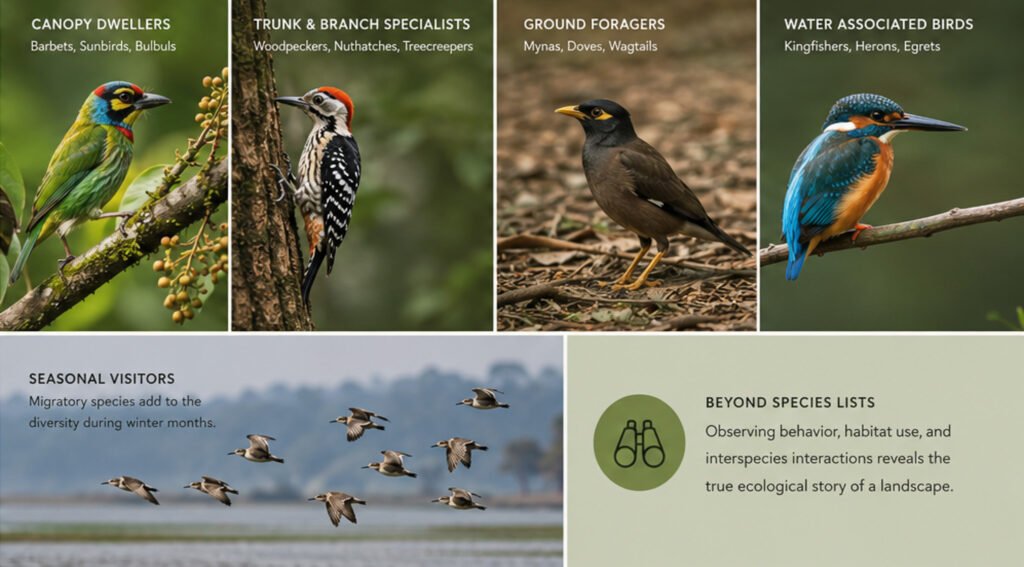
Clearings, pathways, and plantation edges host ground-foraging birds such as mynas, doves, and wagtails. These species exhibit high adaptability and often thrive near human-modified spaces. Their feeding strategies ranging from seed consumption to insect hunting allow them
to exploit disturbed habitats effectively.
Despite their familiarity, these birds are ecologically important. They contribute to nutrient cycling and act as prey for higher-level predators, maintaining food-web integrity.
Lakes and streams introduce a distinct avian component to the region. Kingfishers, herons, and egrets are regular occupants of these areas, each employing specialized hunting techniques. Kingfishers rely on visual acuity and precision dives, while herons adopt patient, stationary strategies.
Water-associated birds are highly sensitive to changes in water quality and availability. Their continued presence indicates stable aquatic conditions and reinforces the importance of preserving wetland features within the landscape.
During winter months, the avian composition subtly shifts. Migratory species arrive from northern and central regions, increasing diversity and altering competitive dynamics. These visitors often occupy similar niches to resident birds but may differ in feeding times or
microhabitat preference.
Observing these interactions provides insight into resource partitioning and the resilience of local bird communities. Seasonal turnover also underscores the importance of Villa Katipadu as part of a larger migratory network rather than an isolated habitat.
While checklists are valuable, understanding birdlife around Villa Katipadu requires moving beyond enumeration. Observing behavior, habitat use, and interspecies interactions reveals deeper ecological narratives. Birds here are not static elements but active participants shaping
and responding to their environment.
For both amateur birders and professional ornithologists, the area offers a living laboratory one where continuity, rather than spectacle, defines its value.