
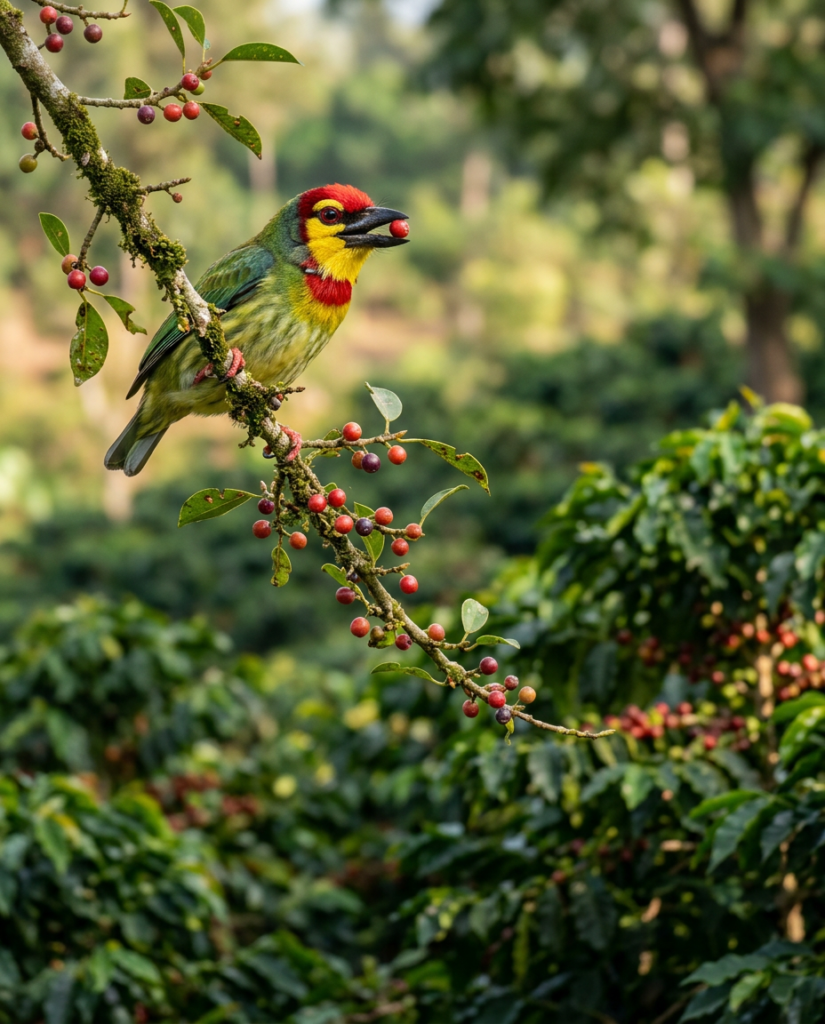
Villa Katipadu sits within a landscape shaped as much by cultivation as by nature. Coffee plants grow in careful rows, paths are cleared and maintained, and yet the space hums with birdlife. To walk through these plantations is to witness a quiet agreement between human intention and ecological persistence.
Coffee plantations, when managed with shade and diversity, are not ecological voids. They are living systems—modified, yes, but far from barren. Around Villa Katipadu, these plantations function as extended habitats, offering food, shelter, and movement corridors for birds that might otherwise be restricted to shrinking forest patches.
The real strength of coffee plantations lies above the crop itself. Shade trees—often native or long-established species—form a secondary canopy that mimics natural forest structure.These trees provide nesting sites, foraging opportunities, and vantage points for birds across trophic levels.
Fruiting trees draw barbets, bulbuls, and other frugivores, while flowering species attract sunbirds and insects that in turn sustain flycatchers and drongos. Raptors perch high, scanning the ground below. This vertical layering is critical. Without it, bird diversity collapses quickly.
In well-shaded plantations, birds are not merely passing through. They linger, return, and raise young.
One of the most underappreciated roles birds play in coffee plantations is insect regulation. Insectivorous birds patrol leaves, bark, and airspace continuously. Their feeding reduces pest populations naturally, often more effectively than chemical alternatives.
Watching this unfold feels subtle but constant. A woodpecker probing a trunk, a flycatcher darting out from a perch, a drongo sweeping low over the plants all are participants in an ongoing ecological negotiation.
This balance benefits both birds and farmers. The plantation remains productive, and birds retain access to food without artificial disruption.
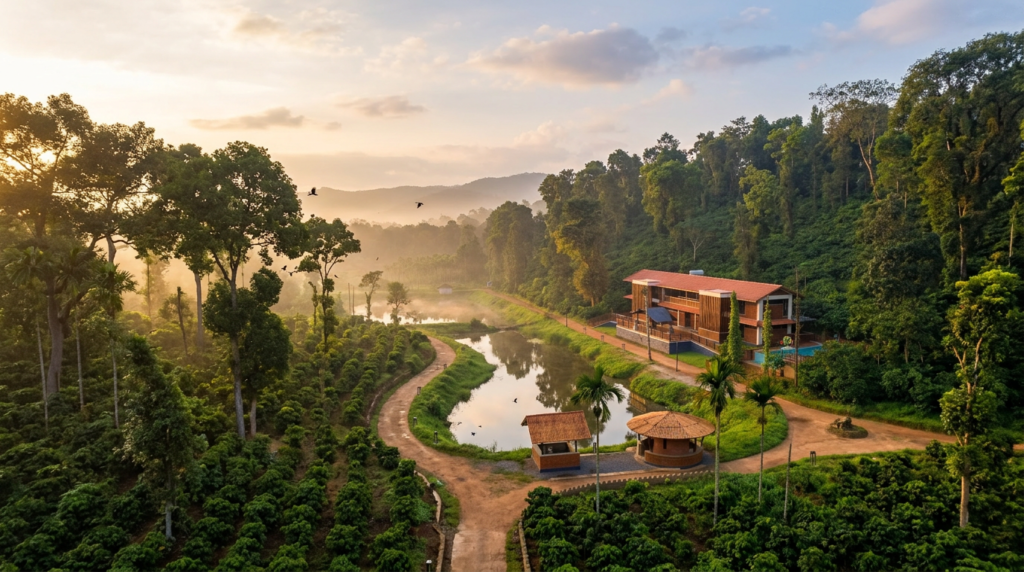
Birds move through plantations with confidence born of familiarity. They learn where flowering cycles peak, where insects emerge after rain, and where human activity remains predictable. Over time, individual birds seem to develop routines that mirror the rhythms of the land itself.
For an observer, this creates moments of quiet intimacy. The same sunbird returns to the same branch each morning. The same barbet calls from the same tree. These repetitions transform anonymous landscapes into known territories.
Beyond their immediate value, coffee plantations act as corridors linking fragmented forest patches. Birds use them to travel safely between habitats, reducing isolation and supporting genetic flow across populations.
This connective role is especially important in regions where continuous forest is no longer guaranteed. At Villa Katipadu, plantations soften the boundary between wild and cultivated, allowing birds to move without abrupt transitions.
The success of birdlife here depends on restraint. Retaining shade trees, limiting chemical use, preserving water bodies, and allowing some undergrowth to remain all contribute to avian resilience.
Villa Katipadu demonstrates that conservation need not always mean exclusion. Sometimes, it means paying attention and allowing nature enough room to adapt.